


When your job posting attracts 1,000 applications in 24 hours, traditional resume screening doesn't just slow down. It collapses. A quick 6-second glance at each resume barely scratches the surface. The real work begins when you try to compare candidate A's 3 years of retail experience against candidate B's 2 years plus a management certification, while remembering how both stack up against the 47 other promising profiles you reviewed an hour ago. Multiply that cognitive load across 1,000 applications and the math becomes brutal: inconsistent evaluations, qualified candidates buried in the pile, and shortlists shaped more by fatigue than merit. By the time you organize your notes into something usable, another 200 applications have arrived.
Resume parsing technology eliminates this bottleneck by automatically extracting candidate data from resumes and converting unstructured documents into searchable, sortable profiles. The difference between filling 50 seasonal positions in two weeks versus two months often comes down to whether your candidate screening system can keep pace with application volume.
This guide focuses specifically on the volume challenge: how to configure parsing and screening systems that handle 1,000+ applicants without sacrificing quality, what metrics matter when hiring at scale, and how to build workflows that turn overwhelming application floods into manageable candidate pipelines.
For a technical deep-dive on how CV shortlisting and parsing technology works, including the different types of parsing software (keyword-based, rule-based, LLM, and hybrid), see our foundational guide. This article builds on that foundation with volume-specific strategies.
|
5x
Faster candidate processing with AI-enhanced screening tools
|
60%
Reduction in hiring cycles with integrated parsing
|
$500
Daily cost per unfilled position in lost productivity
|
2,000+
Applications per posting at recognizable tech companies
|
The Math Problem: Why Volume Breaks Manual Screening
High volume hiring creates a capacity crisis that no amount of recruiter effort can solve. Understanding the specific numbers reveals why automation isn't optional at scale.
Entry-level retail positions routinely attract 400-600 applicants per role. Remote customer service jobs can exceed 1,000 applications within the first week. Tech and engineering postings at recognizable companies hit 2,000+ applications rapidly. Meanwhile, the average time to fill a position stands at 42-54 days, creating pressure to move faster while application volumes continue climbing.
| Open requisitions per recruiter | 15-25 positions |
| Applications per position | × 500 average |
| Total resumes to review | = 7,500 - 12,500 |
| Time at 6 seconds each | = 12.5 - 21 hours |
| Reality check | Impossible without automation |
Consider the recruiter capacity calculation. With 15-25 open requisitions at any given time and each job attracting hundreds of applications, a campus recruiter responsible for intern hiring might face 12,500 resumes to review across their positions, according to Tufts University Career Center analysis. At 6-8 seconds per initial scan, reviewing that volume would consume over 27 hours of focused work. The math simply doesn't work.
The volume problem compounds through three mechanisms.
Backlog acceleration. Applications arrive faster than any team can process them. A posting that receives 100 applications on day one gets 200 on day two and 350 by day three. Meanwhile, recruiters are still working through day one's pile. The gap between incoming and processed applications widens daily.
Quality degradation under pressure. When recruiters race through hundreds of applications, qualified candidates get missed. Nearly 30% of hiring managers admit to losing their top choice because of lengthy recruitment timelines. The irony is that speed pressure created by high volume causes the very slowdowns that lose candidates, as overwhelmed recruiters can't respond quickly enough to keep top applicants engaged.
Cost multiplication. Each unfilled position costs approximately $500 per day in lost productivity. Multiply that across 50 seasonal hires delayed by two weeks, and you've absorbed $350,000 in hidden costs before a single person starts.
50 positions × 14 days delay × $500/day = $350,000 in lost productivity
Plus: recruiter overtime, candidate drop-off, offers declined to faster competitors
Resume parsing addresses this math problem directly. Instead of recruiters spending time extracting data from documents, the technology handles ingestion and structuring automatically. A system that processes applications in seconds rather than minutes creates the capacity headroom that volume hiring demands.
Volume Hiring by the Numbers: Industry Benchmarks
Understanding typical application volumes and hiring timelines helps calibrate expectations and identify where your process underperforms. These benchmarks come from LinkedIn, and SHRM research.
| Industry | Typical Applications/Role | Average Time-to-Fill | Volume Challenge |
|---|---|---|---|
| Retail/Hospitality | 500-1,500 | 14-20 days | High turnover, continuous hiring |
| Remote Customer Service | 1,000+ | 20-30 days | Geographic reach amplifies volume |
| Technology/Engineering | 2,000+ | 44-58 days | Brand recognition drives applications |
| Manufacturing | 300-800 | 25-44 days | 800K open positions industry-wide |
| Seasonal Hiring | 5,000+/week | 30-45 day window | Compressed timeline, peak volume |
| Construction | 200-400 | 12.7 days | Project-based surges |
The consistent pattern across industries: organizations using integrated parsing and automated screening outperform those with manual processes by 40-60% on time-to-hire metrics. The advantage compounds at higher volumes.
Screening Workflow Design for 1,000+ Applicants
Effective high volume screening combines parsing technology with workflow architecture designed for throughput. The goal is directing recruiter attention toward candidates most likely to succeed while maintaining fairness throughout.
Understanding how AI resume parsers extract skills from CVs helps you configure these stages correctly. That article covers the technical pipeline; here we focus on the operational workflow.
| 1. Auto Intake & Parse | → | 2. Knockout Filters | → | 3. Match & Rank | → | 4. Batch Review | → | 5. Auto Assessments | → | 6. Interview & Hire |
Stage 1: Automated intake and immediate parsing. When applications arrive, the system extracts data and populates candidate profiles within seconds. This prevents manual data entry and backlogs accumulating overnight. ATS platforms with integrated parsing can decrease hiring cycles by 60% simply by eliminating the lag between application submission and data availability.
At 1,000+ applications, this stage needs to handle burst traffic. Popular postings may receive 300 applications in the first hour. Systems that queue and process asynchronously maintain responsiveness without losing data.
Stage 2: Knockout filtering. Before any ranking occurs, binary qualification checks remove obviously mismatched candidates. Work authorization status, location requirements, minimum credential thresholds. 100% of recruiters use knockout questions for compliance requirements, but only 8% configure content-based auto-rejection. Most organizations use knockouts sparingly, preserving a broad pool for the next stage.
Stage 3: Requirements matching and ranking. The system compares extracted candidate data against job requirements and assigns relevance scores. A candidate with 90% skills match appears at the top of the list; someone with 40% alignment falls lower. Recruiters still see all candidates but can work through applications in order of likely fit.
For high volume roles, ranking matters more than filtering. Rather than eliminating candidates with 70% match scores, the system surfaces the strongest candidates first. Recruiters work top-down until positions fill.
Stage 4: Batch review of qualified pool. Here the technology hands off to people, but workflow design still matters for volume. Instead of reviewing candidates one-by-one, batch review interfaces show side-by-side comparisons of top-ranked candidates. Recruiters can advance 10-20 candidates in minutes rather than evaluating each in isolation.
Stage 5: Automated assessment distribution. For volume hiring, skills assessments before interviews create scalable evaluation that would be impossible through conversations alone. Assessments create objective data that helps compare large candidate pools without scheduling hundreds of interviews.
When you use Equip's ATS, assessments are available natively without integrating with a third-party assessment provider! View assessment features
Automated distribution sends assessment invitations to qualified candidates immediately after batch approval. No recruiter action required. Completion reminders go automatically. Results flow back to candidate records for the next stage.
Stage 6: Interview scheduling and decision. Candidates who pass assessments move to interviews. Video screening reduces time-to-hire compared to traditional phone screens, making it practical to interview more candidates when high volume requires fast throughput.
Key Insight: Technology Amplifies, Doesn't Replace
Throughout this process, technology amplifies recruiter capacity without removing humans from decisions. The goal: recruiters spend time on candidates who warrant attention, not on data extraction and document processing.
Technology Stack for Volume Throughput
The technology choices you make shape whether your screening process scales smoothly or creates new bottlenecks. For high volume hiring, the stack needs components optimized for throughput, not just functionality.
| Component | Volume Requirement | Key Metric |
|---|---|---|
| ATS with Native Parsing | Batch operations, queue management, API access | 60% faster cycles |
| Assessment Platform | 500+ concurrent test-takers, auto invitations | 91% report faster hiring |
| Communication Automation | Template libraries, conditional sequences, merge fields | 69% reject slow responders |
| Interview Scheduling | Self-service portals, multi-interviewer sync | 10-50% productivity gain |
| Analytics Dashboard | Pipeline visibility, bottleneck identification, source tracking | Continuous optimization |
Pro tip: Start a free trial on Equip to test all of the features above for free.
Applicant tracking system with native parsing and bulk operations. Your ATS serves as the central hub. 97.4% of Fortune 500 companies use an ATS, but not all systems handle volume equally well. Look for: batch actions on candidate groups, bulk status updates, queue management for high-traffic periods, and API access for integrations.
Assessment platform with concurrent capacity. Skills testing thousands of candidates simultaneously requires infrastructure built for scale. Equip supports 90+ languages with AI-powered proctoring, enabling global volume hiring without manual oversight of each session.
Communication automation with sequencing. Volume hiring requires communicating with hundreds of candidates simultaneously. 69% of applicants won't accept a job offer if the company takes too long to respond; automated communication prevents this.
Integration architecture. Data should flow seamlessly between systems: resume parsed in the ATS feeds candidate information to the assessment platform, assessment results update candidate scores in the ATS, interview scheduling pulls from the assessed candidate pool automatically. Fragmented systems create manual transfer points that slow everything down. Your best bet is to find a software that offer an AI-native ATS with resume screening, skill assessments and interviews. (Hint: Yes, the answer is Equip. It has all these features.)
Metrics That Matter for Volume Hiring
High volume hiring success requires tracking metrics that reveal throughput capacity and quality, not just counting applications processed.
Application-to-screen ratio measures what percentage of applications get reviewed within target timeframes. If you're receiving 200 applications daily but only screening 150, you're at 75% and accumulating backlog. Target 100% to stay current.
Time at each stage reveals where candidates get stuck. If parsing and initial screening take hours but candidates wait weeks for interviews, your bottleneck is scheduling, not technology. Break down the journey: application to screening, screening to assessment, assessment to interview, interview to offer.
Recruiter throughput measures how many candidates each team member can process effectively. Before automation, a recruiter might review 50-100 resumes per day with reasonable attention. With parsing and automated screening, the same recruiter should evaluate 500+ candidates meaningfully. If throughput hasn't increased proportionally with technology investment, workflow design needs attention.
First-response time tracks how quickly candidates receive acknowledgment after applying. For volume hiring where candidates apply to multiple similar roles, speed wins. Organizations responding within 24 hours significantly outperform those taking 3-5 days.
Assessment completion rate indicates whether your evaluation process creates friction. If only 40% of invited candidates complete assessments, either the assessment is too long, the invitation timing is wrong, or candidates have already moved on. Target 70%+ completion for entry-level roles.
Quality of hire ultimately determines whether your screening process works. Track new hire performance ratings, time to productivity, and 90-day retention rates. Companies using ATS report 40% lower turnover among new hires compared to those without.
Explore ATS options and find the best free ATS here.
Configuration for Scale: Getting Parsing and Matching Right
How you configure parsing and matching systems determines whether automation helps or creates new problems. These settings matter more at volume because errors multiply across thousands of candidates.
For broader challenges recruiters face during CV shortlisting, including bias, formatting issues, and candidate misrepresentation, see our guide on 5 challenges recruiters face during CV shortlisting. The configurations below specifically address scale-related issues.
Requirement hierarchy. Distinguish must-have qualifications from nice-to-have preferences.
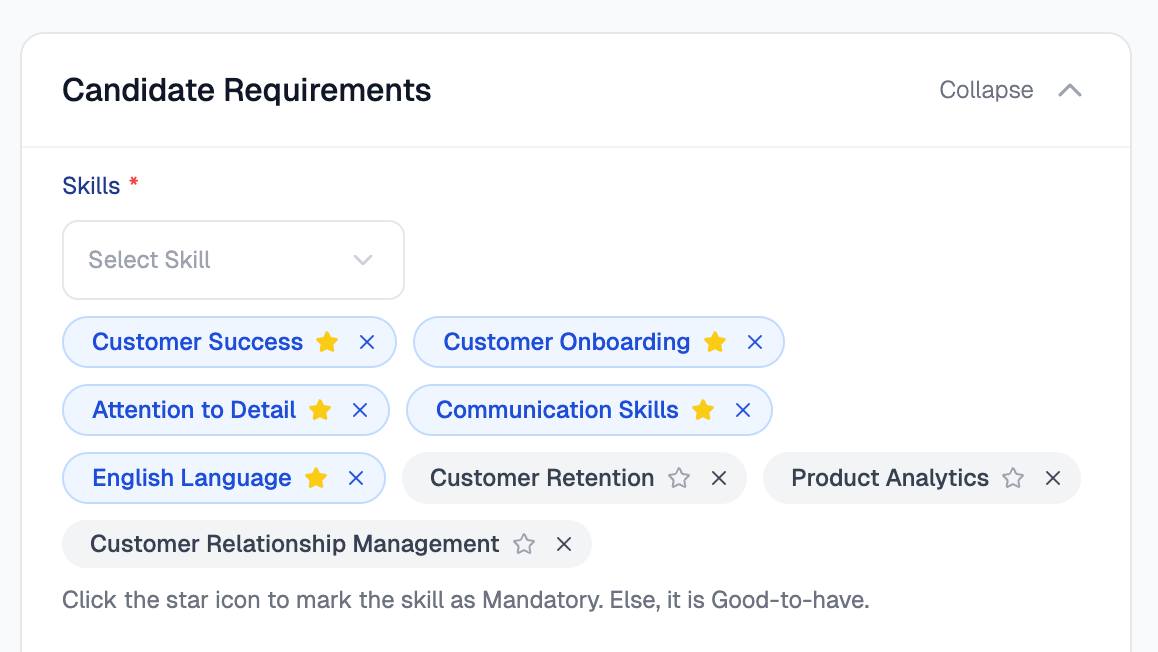
Configure your system to weight requirements differently rather than treating all criteria equally. Harvard Business School's "Hidden Workers" study found that the real problem isn't AI making bad decisions, but humans defining overly narrow criteria that AI faithfully enforces.
Matching thresholds by role type. Different positions need different sensitivity. Entry-level roles might surface anyone above 50% match, ensuring broad pools for volume hiring. Senior technical positions might require 80%+ alignment before reaching recruiter review.
Equip's AI automatically calculates a job fit score when a candidate applies. It also comes with a clear explanation on why the candidate was assigned a certain job fit score. This enables recruiters to screen applications faster.
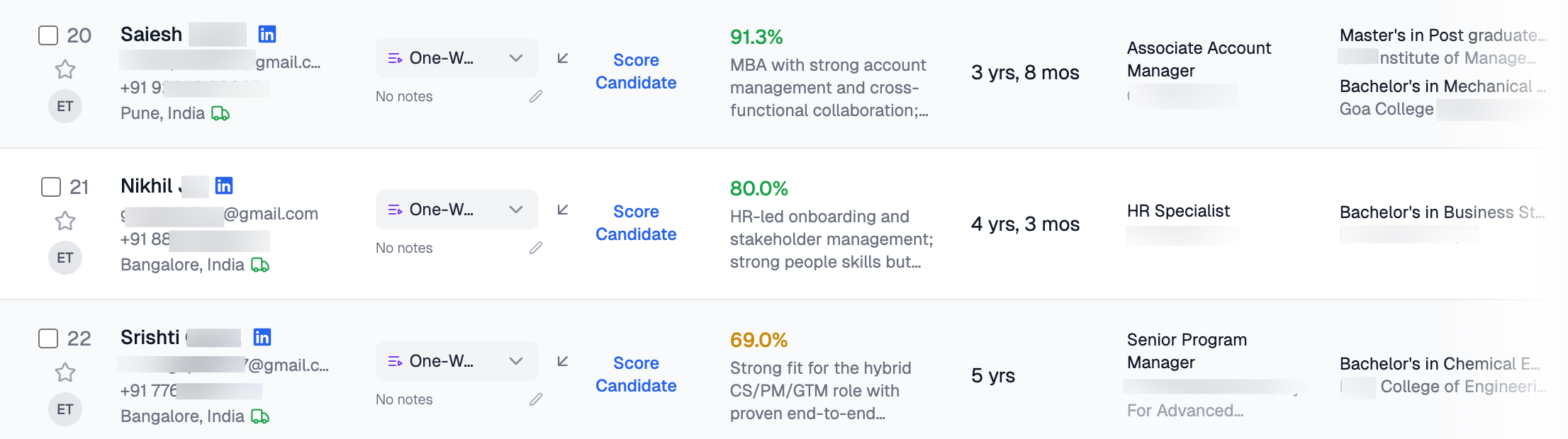
Synonym and skill equivalence mapping. Candidates describe identical skills many different ways. Ensure your system treats "PostgreSQL," "Postgres," and "PgSQL" as equivalent. At volume, even small gaps multiply into significant candidate loss.
Automated stage transitions. Define which pipeline movements happen automatically and which require human approval. For volume hiring, more automation typically improves throughput. Candidates who pass knockout criteria should advance automatically. Assessment invitations should send without recruiter action. Only final hiring decisions truly require human judgment at each instance.
Implementation: Moving from Manual to Volume-Ready
Most organizations implement volume-ready hiring incrementally. This phased approach builds capability while managing risk.
Phase 1: Baseline measurement. Document your current state before changing anything. How many applications do you receive per role? How long does screening take? This baseline lets you measure improvement accurately.
Phase 2: Parsing and ATS optimization. If your ATS has parsing capability you're not fully using, activate it. Configure job templates with clear requirement hierarchies. Test with a small batch of recent applications to verify extraction accuracy.
Phase 3: Pilot with highest-volume roles. Start automated screening with roles that receive the most applications and have relatively standardized requirements. Entry-level positions, seasonal hires, and high-turnover roles make excellent pilots because volume creates pressure that makes automation benefits obvious.
Phase 4: Add assessments. Once core screening works well, configure role-specific skill assessments. Configure automated invitation workflows and results integration.
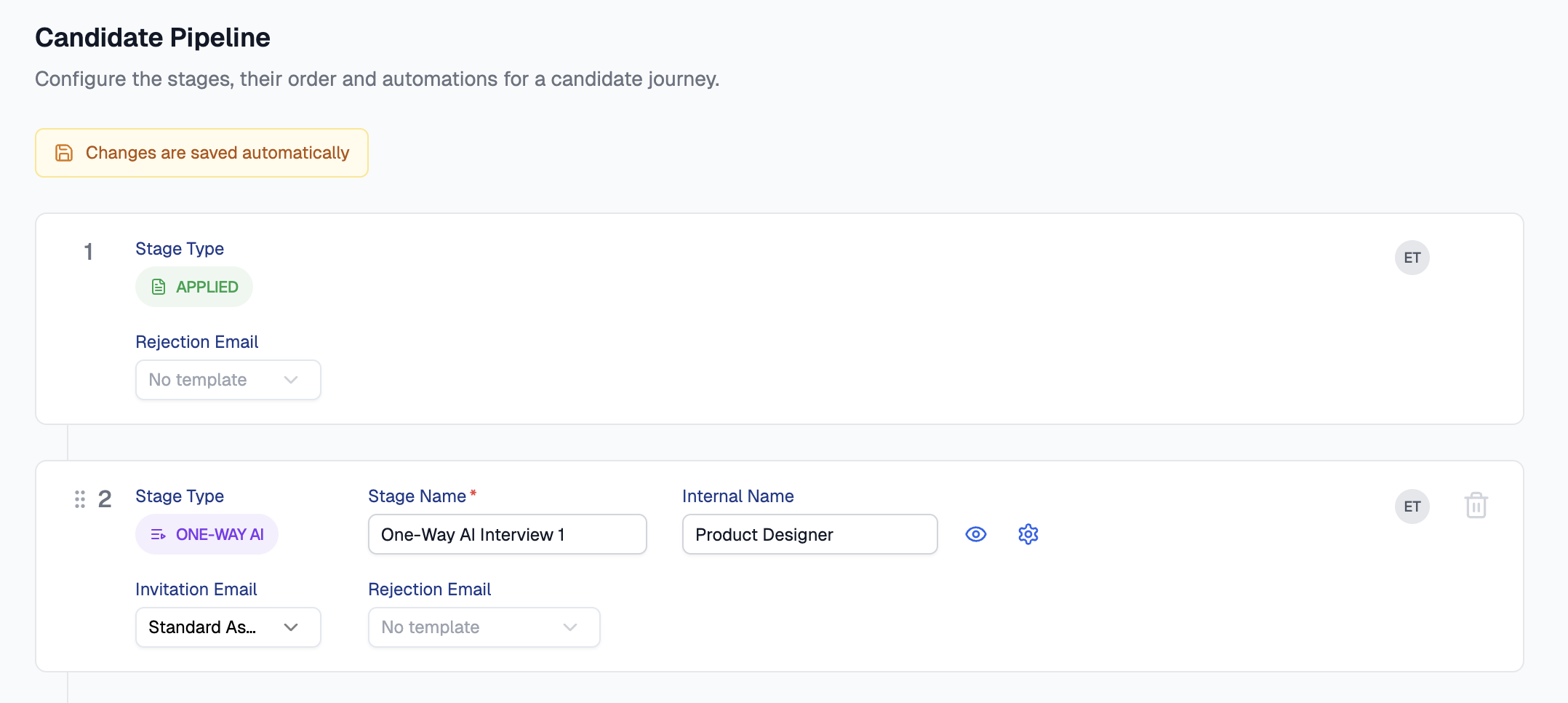
Phase 5: Expand automation scope. Add interview scheduling automation, communication sequences, and reporting dashboards. Each addition builds on the foundation of clean, parsed candidate data.
Phase 6: Continuous optimization. Treat your hiring technology like any business-critical system: monitor performance, track metrics, and improve continuously.
The Volume Hiring Advantage
Organizations that implement intelligent parsing and screening for high volume hiring consistently report faster time-to-hire, lower cost per hire, and improved quality of hire. The technology isn't about replacing human judgment; it's about ensuring human judgment gets applied to the candidates who warrant attention rather than being exhausted on applications that were never going to fit.
The practical steps are clear: choose technology with strong parsing capabilities and volume throughput, configure requirements thoughtfully to avoid over-filtering, pilot with high-volume roles, measure everything, and iterate continuously.
Your next high-volume hiring push doesn't have to mean weeks of manual screening, overwhelmed recruiters, and candidates lost to faster-moving competitors. The technology exists to screen 1,000 applicants as systematically as 10. The competitive advantage goes to organizations that deploy it effectively.
Ready to handle high-volume hiring without the headaches? Equip combines AI-powered assessments with intelligent candidate matching to help you identify top talent at scale. Our platform processes thousands of candidates daily, supporting 90+ languages and providing comprehensive skills evaluation at just $1 per candidate.