



Tech hiring software

The complete tech hiring process, on Equip

Post the job, collect applications, screen resumes, validate skills, interview and make the offer. Equip runs the whole technical hiring process in one place, so you hire developers faster without spending engineer hours.

Alex Morgan Backend EngineerRemoteCandidate journey
2 Oct
Applied
Through the careers page, resume parsed into the form
Careers page
2 Oct
Resume screened
Job-fit score: 6 yrs Go and Postgres, AWS in the last two roles
94% job-fit
5 Oct
Coding test
Backend test, proctored, trust score 98%
86%
8 Oct
AI interview
First round, 28 minutes: API design 9 · Postgres 8.5 · AWS 8
8.6/ 10
14 Oct
Panel interview
Interviewers: strong on system design and ownership, clear communicator; one flagged pace under time pressure
15 Oct
Offer accepted
Candidate signed and confirmed

Free to start. First 10 candidates on us.

See Pricing

Helping 1000+ companies hire the right talent

LG logo
Fortrea logo
Ant International logo
Quest Global logo
Joola logo
Furlenco logo
Jar logo
MyGate logo

How it works

Customised to your workflow. Pick any stage you want.

Start with any stage, add the rest when you are ready, and rename or reorder them in the ATS. Each one narrows the pool so the next costs less.

01. Define the role

Agree the must-have skills, the nice-to-haves and the seniority before a single CV arrives. Everything downstream is scored against this list.

02. Post the job and collect applications

Publish the opening on your Equip careers page, share its link wherever you already source, and every applicant lands in one pipeline.

03. Screen resumes

Reading hundreds of CVs by hand takes a week and produces an inconsistent shortlist. Define the criteria once and let screening run on every application.

04. Validate skills

Test the shortlist, not the whole applicant pool. A short, proctored assessment after screening tells you who can actually do the work.

05. First-round interviews

The bottleneck in most teams is engineer time. Let an AI interview run round one, ask the follow-ups, and hand you a ranked shortlist.

06. Panel interviews and the decision

The humans now meet only the top few. Structured scorecards and side-by-side comparison keep the decision about evidence, not the loudest voice.

07. Offer and close

Good engineers have other offers. Move fast, keep them informed, and send the offer, or the rejection, from the same place the pipeline lives.

Stage by stage

Stage by stage, with Equip at each one

What each stage is for, and what happens on Equip at that point.

Define the role

Agree the must-have skills, the nice-to-haves and the seniority before a single CV arrives. Everything downstream is scored against this list.

Write the must-haves apart from the nice-to-haves, name the stack and the first months' problems, and score every later stage against that list.

Browse the how-to-hire guides by role
New job: Backend Engineer Remote · Full-time
Stages
Applied184
Resume screening46
Coding test19
Technical interview9
Culture round6
Offer3
Skills the role is scored onMust-haves first, nice-to-haves after
Must-have
Python Go PostgreSQL AWS System design
Nice-to-have
Kubernetes Kafka + Add skill
Minimum experience 56years

Post the job and collect applications

Publish the opening on your Equip careers page, share its link wherever you already source, and every applicant lands in one pipeline.

Give every channel the same destination, so each applicant lands in one pipeline once, tagged by where they came from.

Which job boards Equip publishes to
Backend Engineer Live on careers page
From Careers page 92 LinkedIn 41 Referrals 18 Job boards 22 CSV upload 11
Applied184
Alex MorganCareers page
Robin ChenLinkedIn
+40 more from LinkedIn
Screened46
Sam TaylorCareers page
Morgan ReyesJob board
Assessment19
Jordan LeeCSV upload
Interview6
Taylor BrooksCareers page

Screen resumes

Reading hundreds of CVs by hand takes a week and produces an inconsistent shortlist. Define the criteria once and let screening run on every application.

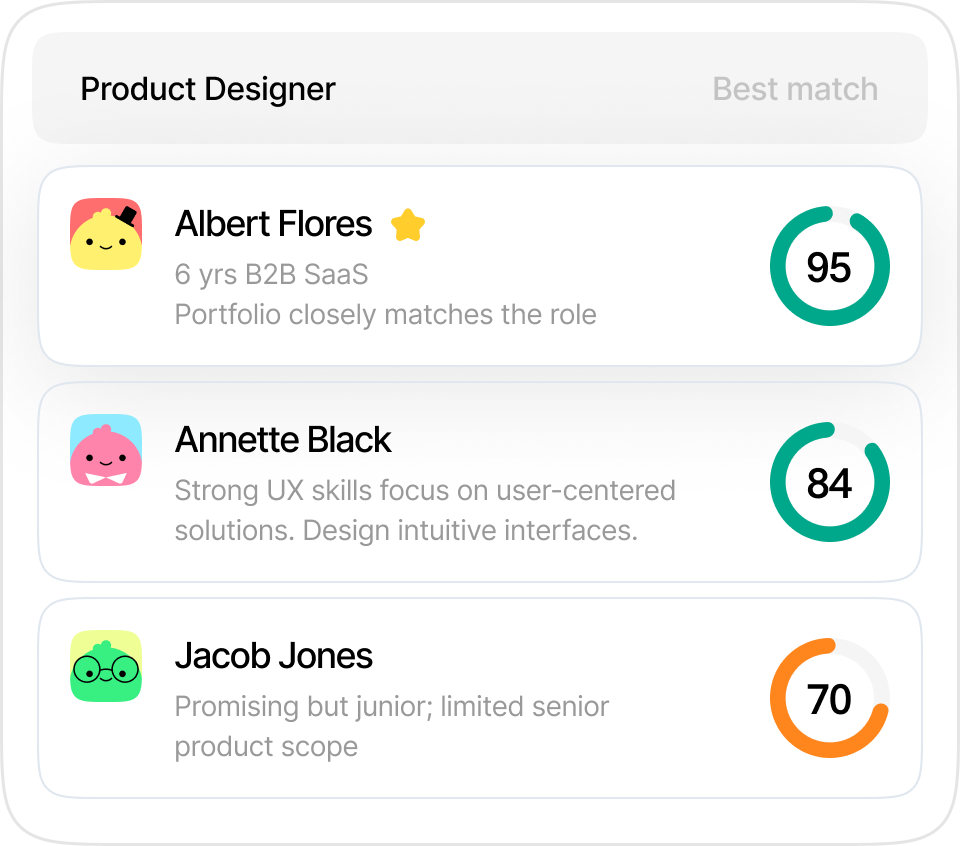
Define a good candidate once and apply it to every application the same way, with a reason beside every score.

How the job-fit score is worked out
What counts, for this job
Skills
Experience
Industry
Preference "Prefers recent AWS experience"
1084 applicants, ranked Job-fit score
Alex Morgan 6 yrs Go and Postgres on payments systems; AWS in the last two roles.
94
Sam Taylor Strong Python and system design; AWS mentioned, not recent.
88
Jordan Lee Backend skills match; 3 yrs, below the seniority asked for.
71
Casey Walsh Frontend-heavy profile; no Go or Postgres in the last five years.
52

Validate skills

Test the shortlist, not the whole applicant pool. A short, proctored assessment after screening tells you who can actually do the work.

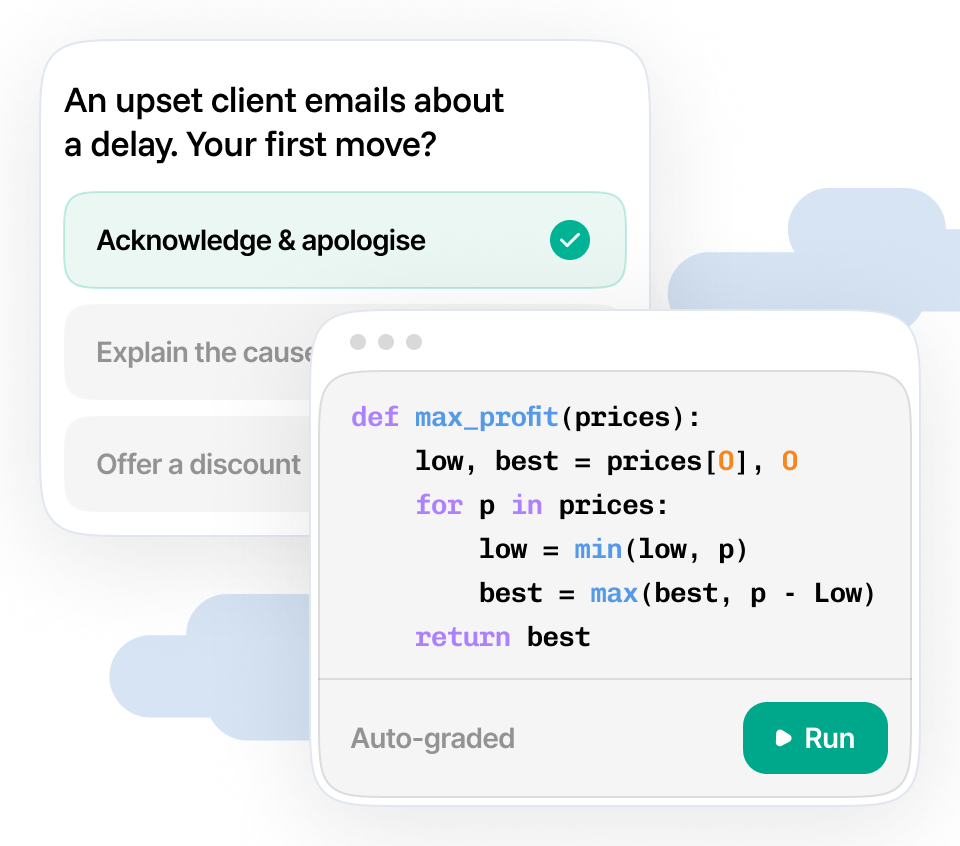
Test the screened shortlist, before any engineer's time, with a short proctored assessment and a cutoff set in advance.

Technical recruitment tests on Equip
Assessment 19 Backend coding test · 60 min
AI proctored
Alex Morgan86 Python 92SQL 80System design 84 Trust score 98%
Sam Taylor74 Python 78SQL 70System design 72 Trust score 95%
Jordan Lee58 Python 61SQL 55System design 60 Trust score 64% · 2 tab switches
Stage automation Score 70 or above: advance to Interview. Below 70: reject with feedback.
Auto-advance on

First-round interviews

The bottleneck in most teams is engineer time. Let an AI interview run round one, ask the follow-ups, and hand you a ranked shortlist.

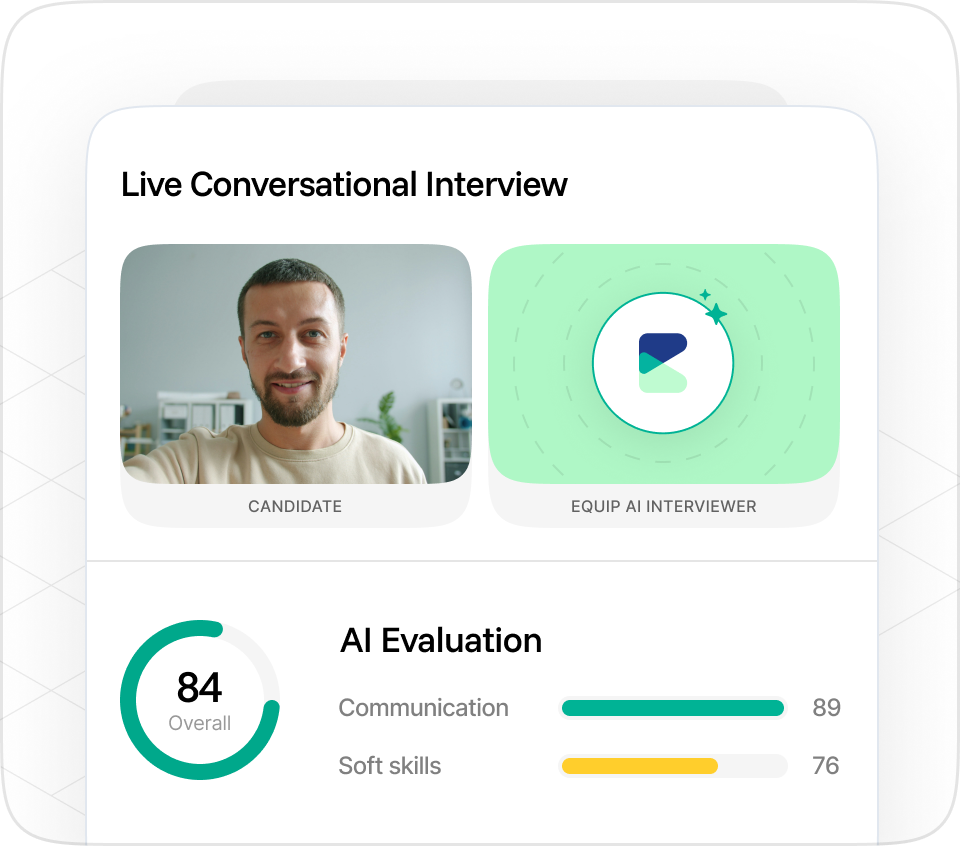
Let a conversational AI interview run round one: the same questions for everyone, follow-ups on the answers, and a report the panel reads in two minutes.

Open a sample AI interview report
Alex Morgan AI interview · 28 min · English
Rank 1 of 14
OverallTopics drafted from the job description
8.6 / 10
API design9
Postgres8.5
AWS8
Incident handling7
Communication9
Transcript Recording Code workspace
Transcript highlights

"We moved the retry logic out of the handler into a queue, so a slow downstream never blocked the API."

Incident handling · 14:20

"Partial indexes on the status column took the p95 from 900 ms to 40 ms."

Postgres · 09:05

"I'd version the endpoint and keep the old shape for a release, then remove it once the clients move."

API design · 04:40

Panel interviews and the decision

The humans now meet only the top few. Structured scorecards and side-by-side comparison keep the decision about evidence, not the loudest voice.

Ask every finalist the same questions, score on a card before the debrief, and decide with every stage's evidence on one record.

Open a sample panel scorecard
Compare finalists
Alex Morgan
Sam Taylor
Robin Chen
Resume fit 94 88 83 Coding test 79 74 84 AI interview 8.6 7.9 8.1 Panel scorecard

Offer and close

Good engineers have other offers. Move fast, keep them informed, and send the offer, or the rejection, from the same place the pipeline lives.

Decide in the debrief, send the offer the same day, tell the other finalists where they stand, then read what the funnel told you.

Sending and tracking an offer
Hiring insights Backend Engineer
Time to hire23days
Offer acceptance91%
Engineer hours14
Rejections by reason
Skills mismatch27
Not enough experience24
No response22
Salary expectations20
Culture fit11
132 rejections with structured reasons
Alex MorganOffer letter · sent today
Backend Engineer, Remote Sign here
Pending acceptance

What you use

Four products, one pipeline

AI-native ATS

The pipeline every other stage reports into. Job openings, stages with owners, automation rules that move candidates on a result, and insights on where hiring slows down. Free on every plan.

AI resume screening

Scores every application against your own definition of a good candidate, with a reason for each score, so the shortlist is consistent and explainable at any volume. Free on every plan.

Skills assessments

Coding tests, SQL, quizzes and role-specific tests with AI proctoring, sent to the screened shortlist from a pipeline stage. Test types and question banks are covered on the technical recruitment page.

Conversational AI interviews

Runs the first round for you: topics drafted from the job description, follow-ups on the answers, an optional code workspace, and a report the panel reads in two minutes.

Metrics

What changes when technical hiring runs on Equip

Three of the four are on the Insights dashboard in the ATS; the fourth you count from your engineers' calendars.

73 %

Faster time to offer

About 12 days from opening to signed offer for a mid-level engineer, against 45 when every round is run by hand.

10 %

Of applicants shortlisted

Screening ranks every CV against the role, so the team only ever meets the top tenth of the pile.

<10 hrs

Engineer hours per hire

An AI interview runs round one, so engineers meet only the top few finalists, with a report in hand.

80 %+

Offers accepted

The offer goes out within two days of the final interview, before a rival's lands.

Mistakes

Six hiring mistakes Equip solves for

Testing everyone who applies

An hour-long test for every applicant burns goodwill and credits. Resume screening ranks the pile first, so only the shortlist gets the assessment.

Interviewing before screening

Engineers lose a working week confirming what the CV already said. A conversational AI interview runs round one and hands them a ranked report.

No written scorecard

Without ratings before the debrief, the loudest voice decides. Each panellist scores on their own card, and the matrix shows where they disagree.

Stages nobody owns

A candidate sits in a stage for a week because nobody was responsible for them. Every stage has an owner, and an automation rule moves candidates on a result.

Not measuring the funnel

An untracked stage stays miscalibrated for the next ten openings. Insights shows pass rates, time in stage and drop-off for every role.

Going quiet after the final round

Finalists who hear nothing accept the offer they already have. The offer letter goes out for e-signature from the pipeline the day the panel decides.

Delhivery

“LinkedIn gave me 750 CVs, I shortlisted ~30, Equip helped me interview 5 of them. Without Equip, I can't screen candidates at scale. Features like custom tests, proctoring are damn good. Best thing is pay per use model.”

Ashish Gupta

Sr Director, Delhivery

FAQ

Frequently Asked Questions

It depends on the role and the market, which is why the number to watch is your own time to hire per role in Insights rather than an industry figure. The stage that usually adds the delay is the first-round interview, because it waits on engineer calendars. Running that round as an AI interview removes the wait: candidates take it the day they are invited, and the panel reads reports instead of booking calls.

After resume screening and before any engineer time. Testing everyone who applies wastes candidate goodwill and credits; testing after interviews wastes the hours already spent. A screened shortlist taking a 30 to 60 minute proctored assessment, with a cutoff set in advance, is the slot that costs least and tells you most.

The seven on this page cover most teams. Smaller teams merge the two interview rounds into one; campus drives add a high-volume assessment at the top before anyone is screened by hand. The ATS lets you add, rename and reorder stages per opening, so the pipeline matches the role rather than the other way round.

Yes. When screening, the assessment and the first interview run without engineers, the panel only meets the top few candidates, however many applied. That is how campus hiring works on Equip for teams with two or three engineers and several hundred applicants.

No. The ATS and resume screening are free on every plan, and assessments and AI interviews are paid per candidate, so each stage can be switched on when it earns its place. Many teams start with assessments or AI interviews and add screening later.

That page covers the tests themselves: test types, question banks, languages and proctoring. This page covers the stages before and after a test, and how they fit together. Hiring for sales, support or operations roles instead? The non-tech hiring guide follows the same seven stages with the tests and interviews those roles need.

Get Started

Start in minutes.First 10 candidates free!

Set up in under 5 minutes. Free to try. No credit card.

Start for free